
- Community Associations, Legal Updates
- Illinois
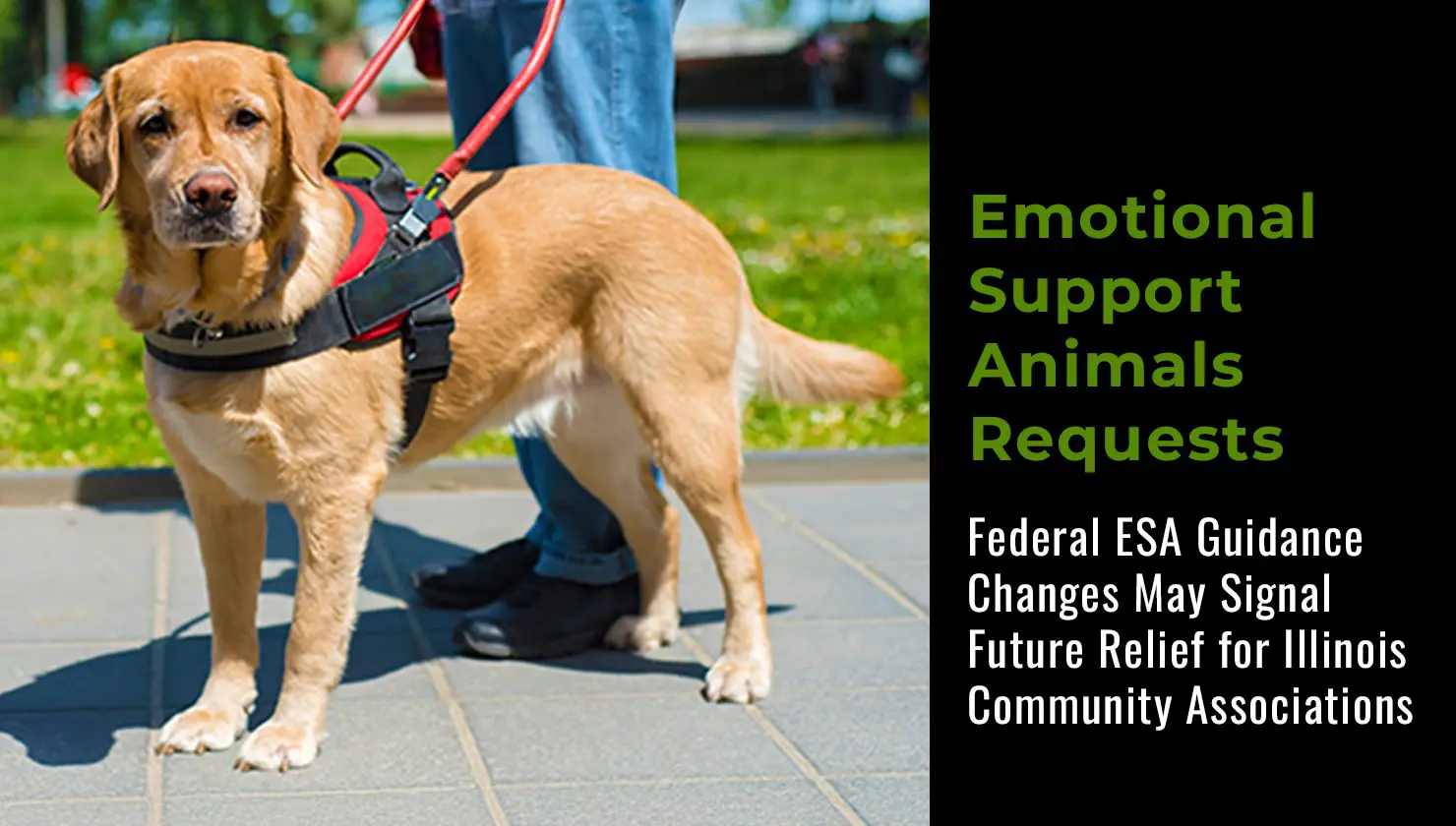
On May 22, 2026, the federal government’s Assistant Secretary for Fair Housing and Equal Opportunity (FHEO) issued an “enforcement memorandum” establishing new, tighter standards for animal-related reasonable accommodation complaints pending under the federal Fair Housing Act (FHA). The FHEO is an agency under the U.S. Department of Housing and Urban Development (HUD).
This federal guideline may create a legal path by which states eventually tighten the rules surrounding an association’s consideration and approval of Emotional Support Animals (ESAs). However, until state-level agencies, state legislative bodies, or state-courts rule otherwise, we continue to advise our clients that ESA requests present condominium, homeowner (HOA), and townhome associations with a high risk of discrimination complaints and civil liability. Accordingly, board members should continue following legal guidance by their association’s attorney.
Our law firm carefully monitors state legislatures, agencies, and courts for their potential response to this new HUD enforcement memo. Given the political environment in states such as Illinois, the legislature may take action to further define what constitutes ESA protections, among other helpful elements that could ease the burden of associations boards and management.
New Federal Guidelines Regarding Emotional Support Animals
The federal Fair Housing Act (FHA) currently prohibits discrimination in housing based upon an individual’s disability. This often requires associations to make reasonable accommodations in rules, policies, practices, or services when such accommodations are necessary to afford a disabled person an equal opportunity to use and enjoy their dwelling.
Key provisions of the recent HUD memo:
- Effective immediately, FHEO will find reasonable cause and pursue further legal action only in cases involving animals individually trained to perform tasks directly related to the person’s disability.
- In pending and future FHEO cases, requests to waive pet policies for untrained ESA’s are no longer presumptively reasonable under the federal enforcement policy.
- Any pending ESA complaints before FHEO will be immediately suspended pending a case-by-case review by the federal Assistant Secretaries office.
- Eventually, FHEO intends on pursuing the formal rulemaking process in order to update FHA’s animal accommodation regulations (which have not been revised since 1989).
The Real-World Difference Between Federal Guidelines vs. State Requirements
The mere fact that one of HUD’s enforcement agencies (FHEO) has issued new enforcement guidelines does not automatically mean that every state must follow.
Under the new HUD memorandum, the operative federal test for Emotional Support Animals (ESAs) requests is whether the animal has been individually trained to perform work or tasks directly related to the individual’s disability. Emotional support, comfort, companionship, and general well-being do not constitute qualifying tasks. However, this legally applies only to associations facing federal HUD complaints for ESA denials. In those cases, the associations are in a substantially better position than before when it comes to defending the association’s ESA denials.
Additionally, the new federal guidelines create reasonable optimism for future state action. In the past, federal enforcement guidelines have often led to states adopting similar requirements. For example, states have historically relied on federal FHA authority and/or federal HUD guidance to define the scope of the protected animal accommodations. Therefore, the fact that FHEO has changed and tightened the scope of their ESA accommodation criteria may bode well for associations in states such as Illinois.
What Does Illinois Require for Emotional Support Animals Requests?
Importantly, even where the new FHEO guidance may support a stricter approach to ESA requests at the federal level, Illinois associations must still comply with the Illinois Assistance Animal Integrity Act. The Integrity Act remains unchanged and continues to provide an independent framework for evaluating assistance animal requests in Illinois.
Currently, Illinois law permits an association to request reliable documentation where a disability or disability-related need for an assistance animal is not readily apparent. Such documentation must establish both the existence of a qualifying disability and the individual’s disability-related need for the animal. In addition, Illinois law requires a genuine therapeutic relationship between the individual and the health care provider supplying the documentation.
Illinois associations therefore retain the authority to scrutinize ESA documentation for compliance with these requirements and to request additional information where the documentation is insufficient. For example, documentation generated through a one-time online evaluation may be insufficient where it does not demonstrate an actual provider-patient relationship or otherwise fails to satisfy the requirements of Illinois law. Accordingly, regardless of the recent HUD memorandum, associations may continue to rely on these Illinois-law requirements when reviewing ESA requests and supporting documentation.
Legal Resource
The federal Fair Housing Act has not been amended. The new enforcement memo merely alters how HUD intends on processing complaints going forward, not necessarily what the statute requires. Moreover, we stress that the HUD memo is explicitly limited to animal accommodation complaints filed under the federal Fair Housing Act. Complaints under other federal statutes are not affected. Additionally, State laws and state level enforcement policies remain unaffected.
However, the new guidelines may indicate better days ahead for association ESA requests. History suggests that changes to federal enforcement guidelines often lead to states adopting similar requirements. Quite often, states have relied on new, federal FHA authority and/or federal HUD guidance to re-define the scope and processing of ESA requests for associations. This could be one of those situations.
Questions about Emotional Support Animal (ESA) requests, accommodations, owner disputes, or other legal concerns?
Please call 855-537-0500 or visit www.ksnlaw.com.
Since 1983, KSN has been a legal resource for condominium, homeowner, and townhome associations. Additionally, we represent clients in real estate transactions, collections, landlord/tenant issues, and property tax appeals. We represent thousands of clients and community associations throughout the US with offices in several states including Florida, Illinois, Indiana, and Wisconsin.
Note: The authors would like to acknowledge the additional research assistance provided by Anna E. Moodhe, Legal Intern, J.D. Candidate, Class of 2027, Northern Illinois University College of Law.
Please note the material contained in this article is for educational and informational purposes only and does not constitute legal advice. No attorney-client relationship is established by your review or receipt of the information contained in this article. You should not act on the information discussed in this article without first obtaining legal advice from an attorney duly licensed to practice law in your State. While KSN has made every effort to include up-to-date information in this article, the law can change quickly. Accordingly, please understand that information discussed in this article may not yet reflect the most recent legal developments. Material is not guaranteed to be correct, complete, or up to date. KSN reserves the right to revise or update the information and statements of law discussed in the article at any time, without notice, and disclaims any liability for your use of information or statements of law discussed in the article, or the accessibility of the article generally. This article may be considered advertising in some jurisdictions under applicable law/s and/or ethical rules/regulations. © 2026 Kovitz Shifrin Nesbit, A Professional Corporation.